
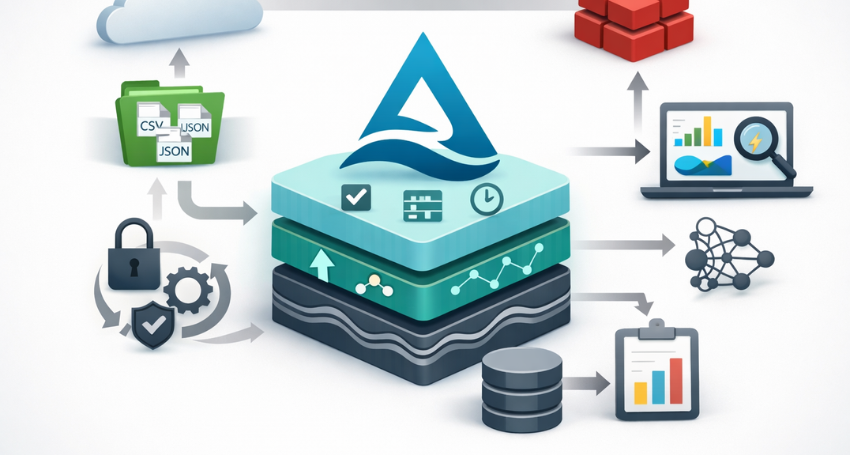
If you work with data engineering, analytics, or AI, you’ve likely heard the question: What is Delta Lake in Databricks? It’s one of the most searched topics in modern data architecture, and for good reason.
Organizations today generate massive volumes of structured and unstructured data. However, managing that data efficiently, reliably, and at scale can be challenging. That’s exactly where Delta Lake comes in. Built into the Databricks Lakehouse Platform, Delta Lake transforms traditional data lakes into reliable, high-performance systems that support analytics, machine learning, and real-time workloads. Let’s break it down in a practical, business-focused way in this blog
What Is Delta Lake in Databricks?
At its core, Delta Lake in Databricks is an open-source storage layer that brings reliability, performance, and governance to data lakes. It combines the flexibility of a data lake with the reliability of a data warehouse.
Traditionally, data lakes store raw data in formats like Parquet on cloud storage systems such as AWS S3, Azure Data Lake Storage, or Google Cloud Storage. While flexible and scalable, these systems often struggle with:
- Data inconsistency
- Duplicate records
- Schema conflicts
- Slow performance for analytics
- Lack of ACID transactions
Delta Lake solves these problems by adding a transactional layer on top of your existing data lake. As a result, teams can build robust data pipelines without sacrificing scalability.
Why Delta Lake Matters for Modern Data Architecture
To truly understand what Delta Lake in Databricks is, it helps to see how it improves modern data platforms.
1. ACID Transactions for Reliability
Delta Lake supports ACID (Atomicity, Consistency, Isolation, Durability) transactions. This means your data remains accurate and consistent even when multiple users or processes write to the same table simultaneously.
Because of this, data engineers can confidently run batch and streaming jobs without worrying about corrupted datasets.
2. Schema Enforcement and Evolution
Schema enforcement prevents accidental data corruption by ensuring incoming data matches the expected structure. Meanwhile, schema evolution allows controlled changes when your data model needs to grow.
This balance gives organizations flexibility without chaos.
3. Time Travel Capabilities
Delta Lake keeps a transaction log that tracks every change. Therefore, users can query previous versions of a dataset.
This feature supports:
- Auditing
- Debugging
- Regulatory compliance
- Data recovery
Few traditional data lakes offer this level of control.
4. High-Performance Queries
Delta Lake uses file compaction and indexing techniques like data skipping and Z-order clustering. As a result, analytics queries run significantly faster.
For businesses relying on dashboards, AI models, or real-time insights, this performance boost directly impacts decision-making speed.
How Delta Lake Fits into the Databricks Lakehouse
Databricks promotes the “Lakehouse” architecture, which combines the best of data lakes and data warehouses. Delta Lake acts as the foundation of this architecture.
Here’s how it fits:
- Storage Layer: Delta Lake manages structured and unstructured data
- Processing Layer: Apache Spark handles transformations and analytics
- Machine Learning Layer: Integrated ML tools support model development
- Governance Layer: Unity Catalog ensures data security and access control
Because everything runs on a unified platform, teams eliminate data silos and reduce complexity.
At Amin’s Consulting, we often see companies struggle with fragmented systems—separate tools for ETL, warehousing, BI, and ML. Delta Lake in Databricks simplifies this ecosystem dramatically.
Common Use Cases of Delta Lake in Databricks
Understanding real-world applications makes it easier to grasp what is Delta Lake in Databricks and why it matters.
Real-Time Data Pipelines
Delta Lake supports both batch and streaming workloads. For example, organizations can ingest streaming IoT data while simultaneously running historical analytics on the same dataset.
Data Warehousing on the Lake
Many businesses now replace traditional data warehouses with Delta Lake-powered lakehouses. This shift reduces infrastructure costs while maintaining high query performance.
Machine Learning and AI
Data scientists need reliable, versioned datasets. With Delta Lake’s time travel and transaction log, teams can reproduce experiments and maintain clean training data.
Regulatory and Financial Reporting
Because Delta Lake ensures ACID compliance and auditability, it works well in highly regulated industries like finance and healthcare.
Key Benefits for Businesses
When clients ask us what is Delta Lake in Databricks and why they should care, we highlight the business impact:
- Improved data reliability
- Faster analytics performance
- Reduced data engineering complexity
- Lower total cost of ownership
- Seamless scalability in the cloud
Moreover, organizations gain a future-proof architecture that supports advanced analytics and AI initiatives.
Delta Lake vs Traditional Data Lakes
Traditional data lakes store raw data cheaply. However, they often become “data swamps” due to poor governance and inconsistent pipelines.
Delta Lake solves this problem by adding:
- Transaction logs
- Schema validation
- Data versioning
- Optimized query performance
Consequently, businesses maintain both flexibility and control.
Implementing Delta Lake Successfully
While Delta Lake offers powerful capabilities, successful implementation requires strategic planning. Organizations must design scalable data models, configure cluster optimization, and implement proper governance frameworks.
That’s where experienced consulting partners make a difference.
At Amin’s Consult, we help businesses design, implement, and optimize Databricks Lakehouse solutions. From architecture design to performance tuning and migration from legacy systems, our team ensures you maximize your investment in modern data platforms.
If you’re exploring what Delta Lake is in Databricks for your organization or planning to modernize your data infrastructure, our experts can guide you every step of the way.
Final Thoughts
So, what is Delta Lake in Databricks?
It’s a powerful storage layer that transforms traditional data lakes into reliable, high-performance, and scalable lakehouse systems. By combining ACID transactions, schema enforcement, time travel, and performance optimization, Delta Lake empowers businesses to unlock trusted insights from their data.
In today’s data-driven economy, organizations cannot afford unreliable pipelines or fragmented systems. Delta Lake provides the foundation for modern analytics, machine learning, and enterprise-scale data management. Ready to modernize your data platform? Contact us build a scalable, secure, and future-ready Databricks solution tailored to your business goals.